Molecules in optical tweezers
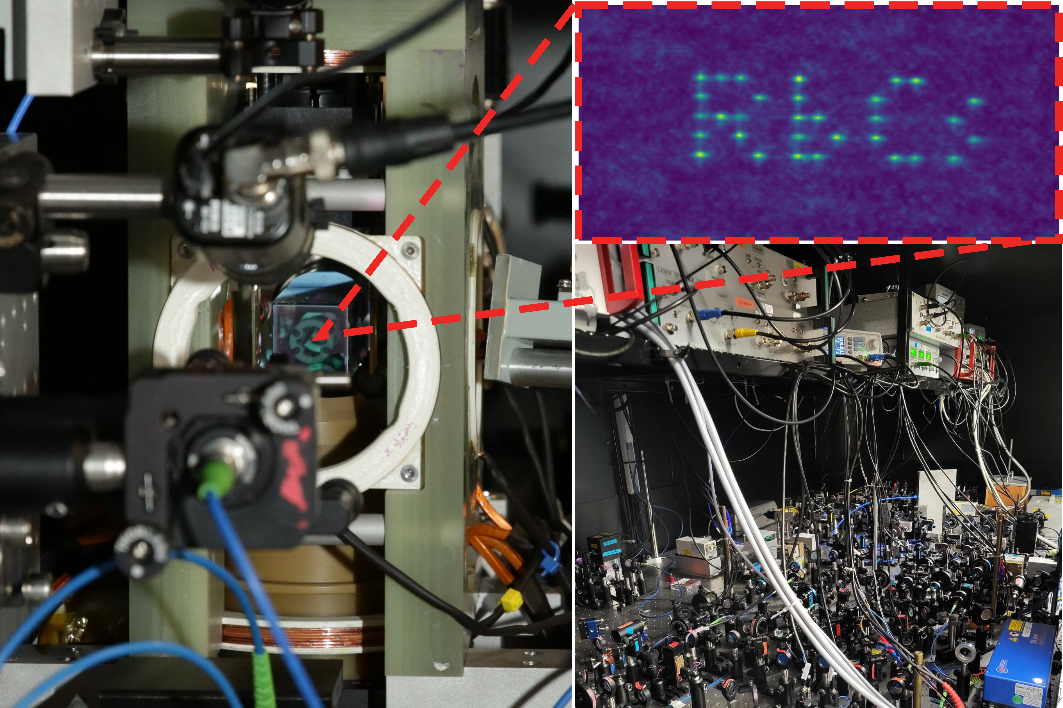
Tweezer experimental apparatus showing the vacuum chamber where we create arrays of individually trapped RbCs molecules.
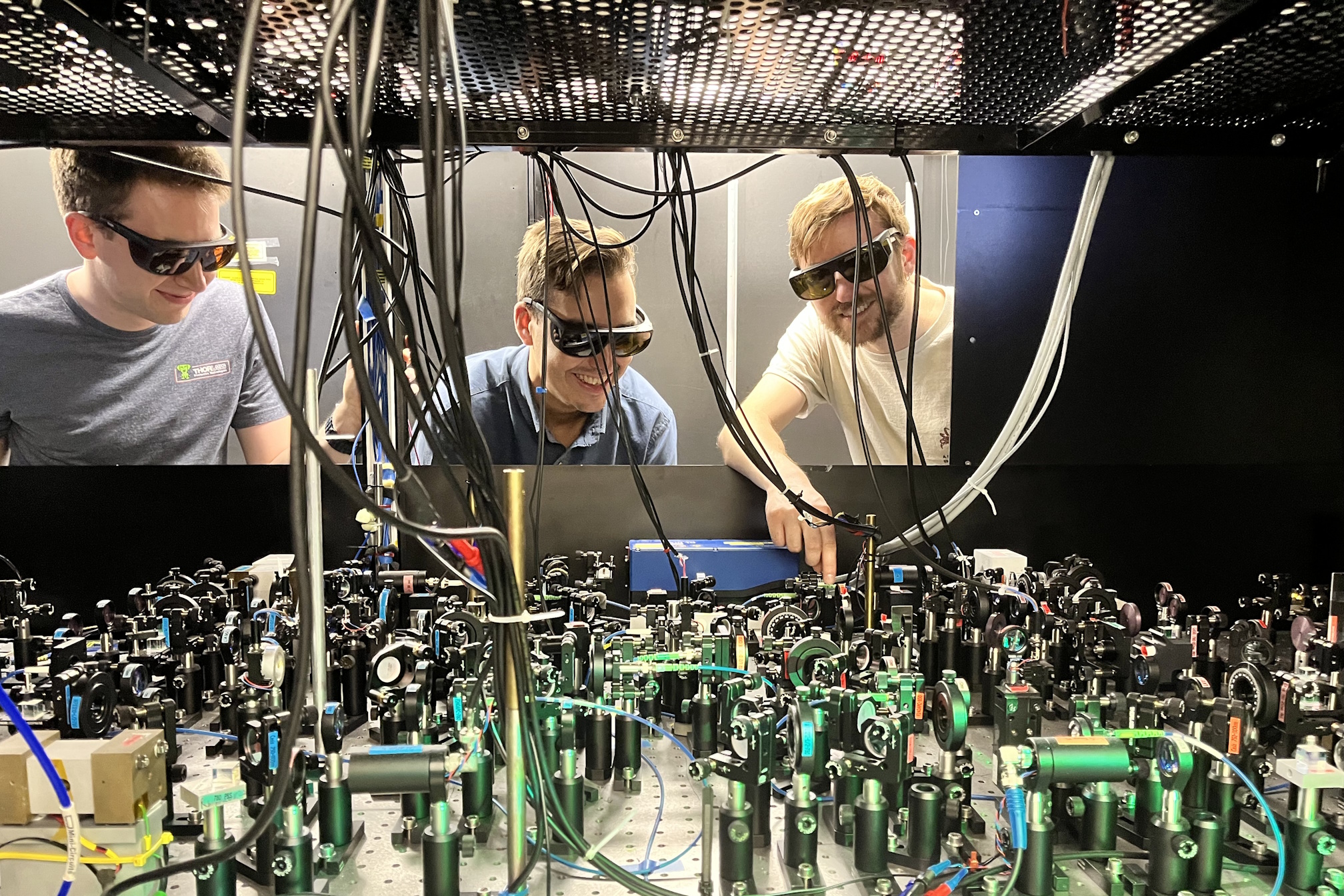
Some light alignment.
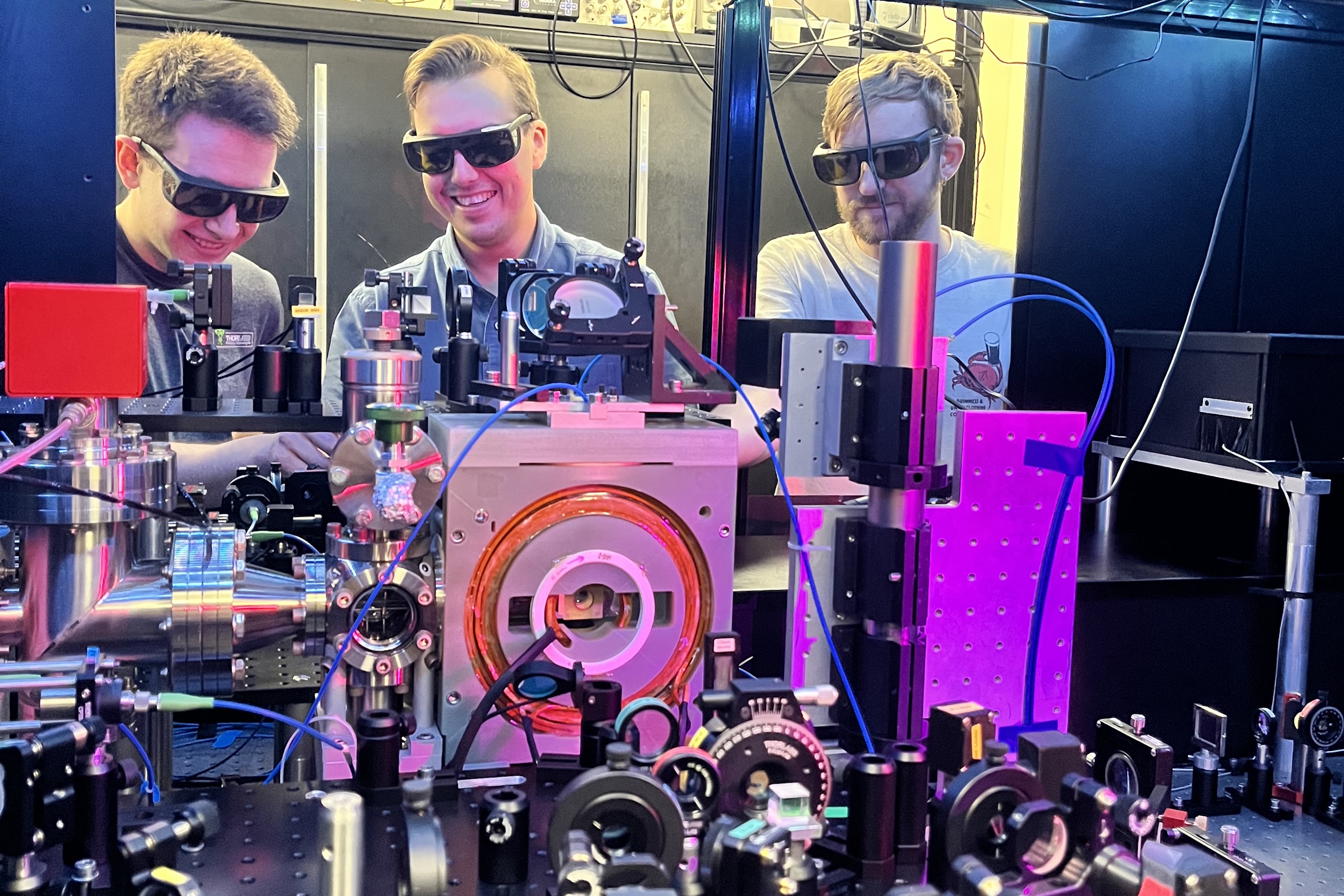
Some of the team, looking for some atoms.
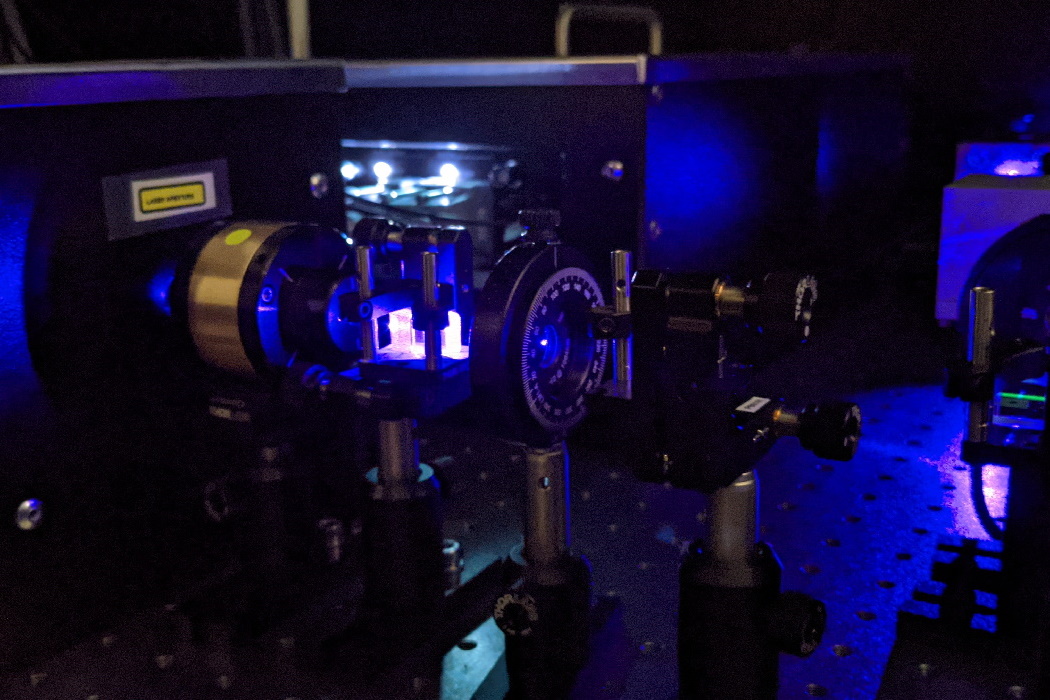
420 nm laser light used to excite Rb atoms to energetic Rydberg states.
Overview
In this experiment we build arrays of ultracold 87Rb133Cs molecules one molecule at a time. Each molecule is assembled from a single Rb atom and a single Cs atom held in optical tweezers, which are tightly focused laser beams that each trap one particle. Because every molecule sits in its own tweezer, we can prepare, control, move and detect each one individually. We can also bring molecules and atoms together in a controlled way to engineer interactions between them.
Polar molecules are a promising platform for quantum science. Their many long-lived rotational states give a natural way to store quantum information. Their electric dipole moments produce long-range interactions that we can switch on and off with microwave fields. Combined with the single-particle control offered by optical tweezers, these properties open new routes to quantum simulation of interacting spin models, quantum computing with molecular qubits and qudits, and studies of collisions and chemistry one particle at a time.
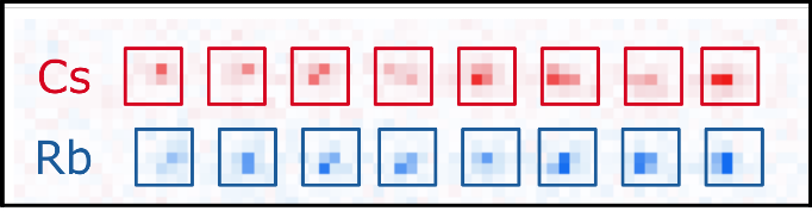
Single Cs (red) and Rb (blue) atoms in a one-dimensional array of optical tweezers. Each Rb–Cs pair is later associated into a single RbCs molecule.
Our research
Assembling molecules atom by atom
We start by loading single Rb and Cs atoms into arrays of tweezers and cooling each atom to the motional ground state of its trap. We then prepare exactly one atom of each species in the same tweezer and associate the pair into a weakly bound molecule. We have shown that molecules can even be formed during the merging of the two tweezers. Finally, we transfer each molecule to its rovibrational ground state. Building on this, we developed a toolbox for preparing, controlling and reading out individually trapped ground-state molecules, including the ability to detect sites where molecule formation has failed.
Long-lived coherence and entanglement
Interactions between molecules are only useful if the quantum states involved survive long enough to use. We engineer rotationally magic optical tweezers, in which the trapping light shifts the energies of two rotational states equally. This removes a major source of decoherence for trapped molecules. In these traps we entangled pairs of molecules using their dipolar spin-exchange interaction and showed that the entanglement is long-lived. We have since moved beyond two-level qubits, encoding long-lived coherences and spin-1 dynamics in three rotational states and studying isolated networks of quantum states within the rich internal structure of the molecule.
A hybrid quantum system of molecules and Rydberg atoms
Our tweezers can also hold individual Rb atoms, which we excite to Rydberg states using 420 nm laser light. Rydberg atoms interact strongly with nearby atoms and molecules over micrometre distances. Combining them with polar molecules has been proposed as a hybrid quantum system, where the atoms provide fast, strong interactions and the molecules provide long-lived storage of quantum information. We observed Rydberg blockade between a single atom and a single molecule, caused by the charge–dipole interaction, and assembled individual Rb*Cs Rydberg molecules. Most recently, we engineered a coherent quantum interface between an individual Rydberg atom and an individual polar molecule using resonant dipolar interactions. This is a key step towards using Rydberg atoms to entangle, control and read out molecules.
Videos
Watch our short video to learn more about our work:
Lab publications
Papers
[14] A coherent quantum interface between a neutral atom and a polar molecule
Daniel K. Ruttley, Tom R. Hepworth, Juan M. García-Garrido, Caleb J. H. Rich, Rosario González-Férez, Alexander Guttridge, Simon L. Cornish
arXiv:2607.15976 (2026)
[13] Isolated quantum-state networks in ultracold molecules
Tom R. Hepworth, Simon L. Cornish, Philip D. Gregory
Commun. Phys. (2026)
[12] Long-lived multilevel coherences and spin-1 dynamics encoded in the rotational states of ultracold molecules
Tom R. Hepworth*, Daniel K. Ruttley*, Fritz von Gierke, Philip D. Gregory, Alexander Guttridge, Simon L. Cornish
Nat. Commun. 16, 7131 (2025)
[11] Individual assembly of two-species Rydberg molecules using optical tweezers
Alexander Guttridge, Tom R. Hepworth, Daniel K. Ruttley, Aileen A. T. Durst, Matthew T. Eiles, Simon L. Cornish
Phys. Rev. Lett. 134, 133401 (2025)
[10] Long-lived entanglement of molecules in magic-wavelength optical tweezers
Daniel K. Ruttley*, Tom R. Hepworth*, Alexander Guttridge, Simon L. Cornish
Nature 637, 827 (2025)
[9] Ultralong-range Cs-RbCs Rydberg molecules: Nonadiabaticity of dipole moments
D. Mellado-Alcedo, A. Guttridge, S.L. Cornish, H.R. Sadeghpour and R. González-Férez
Phys. Rev. A 110, 013314 (2024)
[8] Enhanced quantum control of individual ultracold molecules using optical tweezer arrays
Daniel K. Ruttley, Alexander Guttridge, Tom R. Hepworth, Simon L. Cornish
PRX Quantum 5, 020333 (2024)
[7] Observation of Rydberg blockade due to the charge-dipole interaction between an atom and a polar molecule
Alexander Guttridge*, Daniel K. Ruttley*, Archie C. Baldock, Rosario González-Férez, H. R. Sadeghpour, C. S. Adams, Simon L. Cornish
Phys. Rev. Lett. 131, 013401 (2023)
[6] Formation of ultracold molecules by merging optical tweezers
Daniel K. Ruttley*, Alexander Guttridge*, Stefan Spence, Robert C. Bird, C. Ruth Le Sueur, Jeremy M. Hutson, Simon L. Cornish
Phys. Rev. Lett. 130, 223401 (2023)
[5] Feshbach spectroscopy of Cs atom pairs in optical tweezers
R. V. Brooks*, Alexander Guttridge*, Matthew D. Frye, Daniel K. Ruttley, Stefan Spence, Jeremy M. Hutson, Simon L. Cornish
New J. Phys. 24, 113051 (2022)
[4] Preparation of 87Rb and 133Cs in the motional ground state of a single optical tweezer
Stefan Spence, R. V. Brooks, Daniel K. Ruttley, Alexander Guttridge, Simon L. Cornish
New J. Phys. 24, 103022 (2022)
[3] Preparation of 87Rb and 133Cs in the motional ground state of a single optical tweezer
R. V. Brooks, Stefan Spence, Alexander Guttridge, A. Alampounti, A. Rakonjac, L. A. McArd, Jeremy M. Hutson, Simon L. Cornish
New J. Phys. 23, 065002 (2021)
[2] Robust entangling gate for polar molecules using magnetic and microwave fields
M. Hughes, M.D. Frye, R. Sawant, G. Bhole, J.A. Jones, S.L. Cornish, M.R. Tarbutt, J.M. Hutson, D. Jaksch and J. Mur-Petit
Phys. Rev. A 101, 062308 (2020)
[1] Ultracold polar molecules as qudits
R. Sawant, J.A. Blackmore, P.D. Gregory, J. Mur-Petit, D. Jaksch, J. Aldegunde, J.M. Hutson, M.R. Tarbutt and S.L. Cornish
New J. Phys. 22, 013027 (2020)
PhD theses
Daniel Ruttley: A Hybrid Quantum System of Ultracold Polar Molecules and Rydberg Atoms (2024)
Stefan Spence: Assembling Single RbCs Molecules with Optical Tweezers (2023)
Vincent Brooks: Control and Collisions of 87Rb and 133Cs Atoms in Optical Tweezers (2022)